
How to Choose a Suitcase: What Actually Matters From a Seasoned Traveler
I just ordered a new suitcase set, which felt like the perfect moment to share what I actually look for when choosing luggage as a seasoned traveler.
If you’re trying to choose a suitcase, you’ve probably noticed how overwhelming the options are. There are countless brands and models, all claiming to be the best. On paper, they all sound the same. Smooth wheels. Durable materials. Lightweight design. Strong zippers.
But after years of travel, you learn very quickly that not all suitcases perform the same once they’re actually put to the test.
This post is about what actually matters when choosing a suitcase, and which features make a real difference over time.
For context, I’ve been working remotely and traveling the world for over 10 years, across 33+ countries, often living out of a suitcase rather than unpacking at home. When you travel that way, suitcase decisions stop being theoretical. You learn what holds up, what fails under pressure, and which features protect you when you’re overpacking, rushing through airports, or navigating long travel days.
Through years of trial and error, I’ve learned what I personally prioritize in a suitcase now, and just as importantly, what I don’t.
At its core, choosing the right suitcase comes down to a handful of non-negotiables. Regardless of brand or budget, these are the things that matter most over time:
When choosing a suitcase, look for:
Durable materials that resist cracking and impact
Smooth spinner wheels that glide easily under full weight
Adjustable retractable handles with multiple height settings
Expandable compartments for flexible packing
A solid warranty that covers wheels, handles, and structural damage
These criteria apply whether you’re buying a carry on, a checked bag, or a full set, and they’ll save you from a lot of frustration down the line.

Table of Contents
- Quality and Durability Matter More Than Anything Else
- Expandability Is a Game Changer
- Lightweight Materials Matter More Than You Think
- Side Carry Handles Are an Underrated Essential
- Strong Retractable Handles Make a Real Difference
- Smooth Spinner Wheels Affect Your Entire Travel Experience
- Warranties Are Not Optional
- TSA Locks Are Situational, Not a Priority
- Color Choice and Why It Actually Matters
- Why I Chose a Samsonite This Time
- How My Most Recent Suitcase Choice Measured Up
- Final Thoughts
Quality and Durability Matter More Than Anything Else
I’ve traveled to over 30 countries, but more importantly, I’ve been on hundreds of flights, and over time I’ve learned that quality and durability are everything when it comes to choosing a suitcase.
There will be moments when you overstuff your bag. Maybe you’re buying things abroad. Maybe you’re relocating. Maybe you’re just trying to make everything fit so you don’t have to check another bag.
We’ve all had those moments where you’re sitting on your suitcase, trying to squish everything down, hoping the zipper holds.
If you have a poor quality zipper, that moment becomes your breaking point.
I’ve even seen suitcases come off airport conveyor belts with half their contents spilling out because a zipper split. Once something like that happens, your trip immediately becomes more stressful than it ever needed to be.
And it’s not just about how you pack. Airport staff are tossing, stacking, and sliding suitcases around under pressure. Your suitcase needs to survive both you and the airport.
Once you’ve had a suitcase fail on you, whether it’s a zipper splitting or material tearing, especially when you’re in the middle of trying to catch a flight, you stop looking at features in isolation. You start thinking about how everything works together under pressure, especially when you’re packing more than you planned.
That’s where durability stops being a buzzword and starts being a real decision making factor.
How to Find a Durable, High Quality Suitcase
When I talk about quality and durability, I’m not talking about vague marketing claims. I’m talking about construction.
Start with the zipper.
Zippers are one of the most common failure points, especially when you pack tightly. I look for thick, reinforced zippers that feel sturdy and designed to handle tension. Thin, flimsy zippers are often the first thing to give out when a suitcase is under stress so avoid at all costs.
Pay attention to the shell material.
The material your suitcase is made of matters.
First, I should mention, I’ve written-off fabric-based materials because any bit of water can soak through into your belongings. And pro-tip: Even if you’re going to a warm destination sometimes to condensation from the plane can create enough water to make your belongings wet. So any fabric-type of suitcase is an immediate no-go for me.
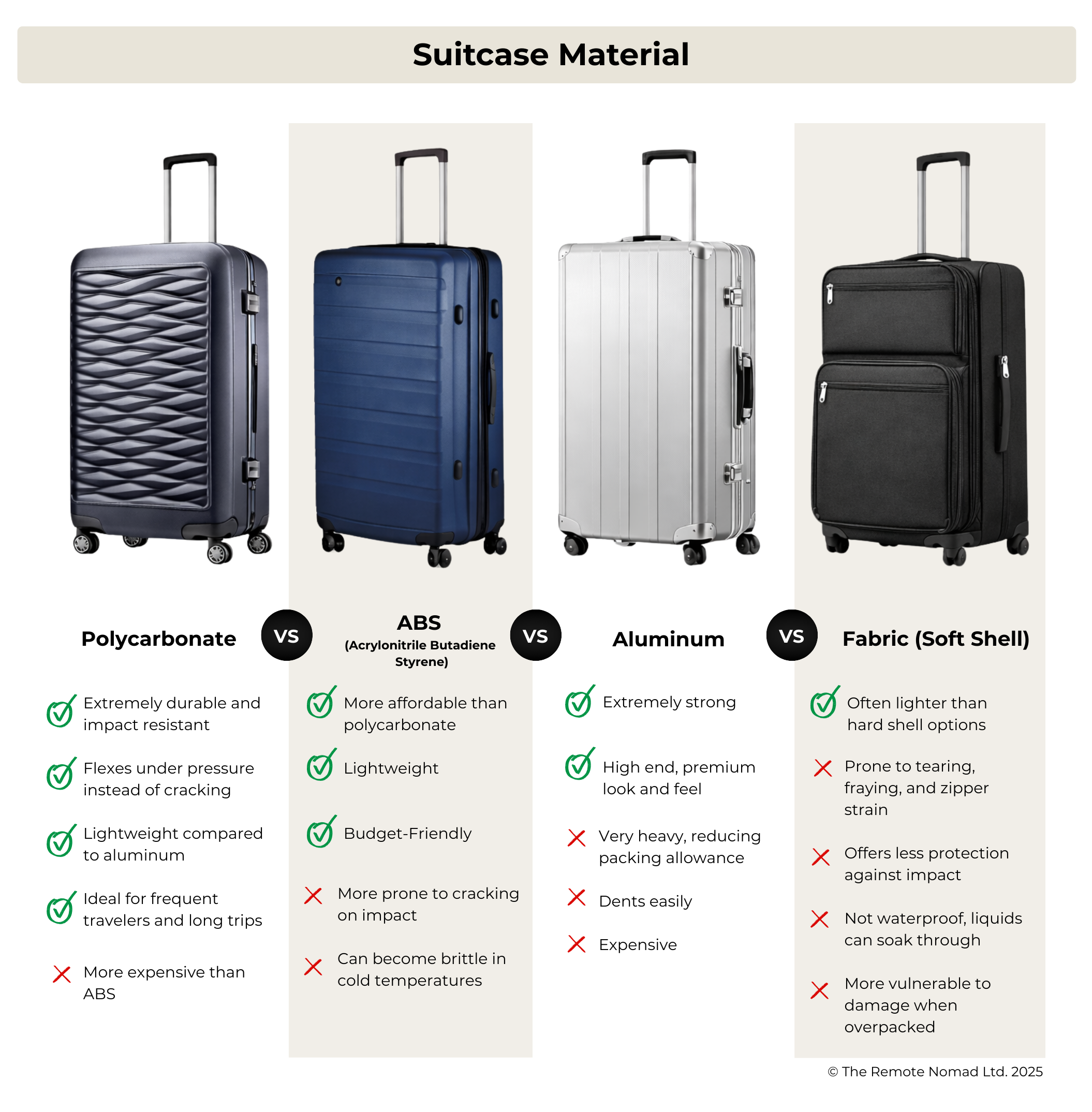
However, even if you get a hardshell suitcase, you need to make sure it doesn’t crack. Polycarbonate is my preference because it flexes instead of cracking. A suitcase that can absorb impact will last significantly longer than one that shatters or splits the first time it takes a hit.
Look at how brands talk about durability.
When choosing a durable, high-quality suitcase consider how the brand talks about their durability. Do they explain the materials they use? Do they mention reinforced zippers, impact resistance, or stress testing? Do they back it up with a solid warranty?
Certain brands have built reputations around durability for a reason. Brands like Samsonite, Travelpro, and Briggs & Riley are often known for prioritizing construction and longevity over aesthetics. That doesn’t mean every suitcase they make is perfect, but it does mean durability is usually part of their core design philosophy.
Personally, I’ve never had a Travelpro and Briggs & Riley but I have had a Samsonite and it was absolutely incredible for durability. I had a Samsonite carry on bag. This was a while bag and was that “over the should strap” type carry on before the carry ons with wheels were a thing. The only reason I got rid of my Samsonite carry on bag is because I wanted a carry on with wheels (and not straps). Otherwise, Samsonite withstood the test of time. This included a year-long trip around the world to 13 countries. Needless to say, I stand behind Samsonsite’s durability.
Always check real world reviews.
How the brand talks about themselves is one thing, but hearing from other real people about their experience is another. Always check real-world reviews. Not just the star rating, but the patterns. Are people consistently mentioning broken zippers, cracked shells, torn interior lining, or wheels failing after only a few trips? Or are they talking about suitcases holding up after years of heavy use?
Quality isn’t about one feature. It’s about whether the…
Zipper
Shell
Interior materials
Wheels, and
Handles
… are all built to work together when the suitcase is under stress.
Once you get this part right, everything else becomes secondary, and that’s when choosing a suitcase starts to feel a lot simpler.
Expandable Zippers Are a Game Changer
Expandability has helped me so much throughout my travels.
First, just to be clear on what I mean by expandable.
An expandable suitcase has an additional zipper that allows the suitcase to widen, usually by a few extra inches. When it’s closed, the suitcase stays compact. When you need more room, you unzip the expansion panel and gain extra space without forcing everything into the main compartment.
And that difference matters more than people realize.
There are many times when you are still under the airline weight limit, but you simply do not have the space to fit everything. Expandable suitcases solve that problem immediately.
What surprised me most, though, is how much expandability helps protect the suitcase itself, not just make packing easier.
When you force everything into the original zipper, you are creating constant tension on that zipper. Over time, that tension is exactly what causes zippers to fail. This is especially true when you’re packing tightly or sitting on your suitcase trying to get it closed.
With an expandable suitcase, you ease that pressure.
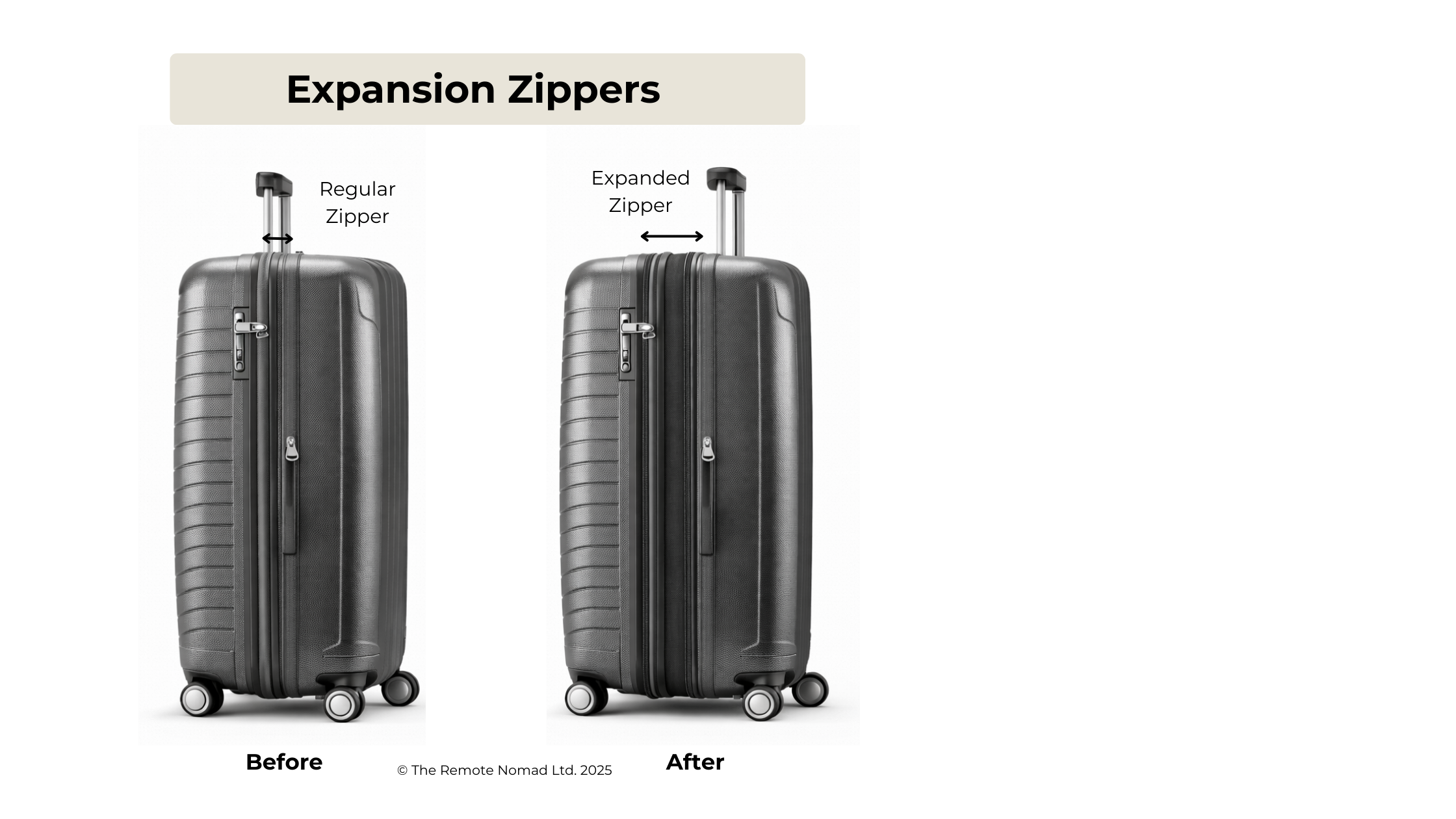
Sometimes I’ll even close the expandable zipper just to check the bag in, then expand it again once I get it back. That extra room removes strain on the zipper and the interior lining, which helps the suitcase last longer overall.
Think of expansion as stress relief, not just extra space. It’s not only about fitting more things. It’s about reducing pressure on zippers, seams, and interior mesh when you’re packing tightly.
Expansion matters more on larger checked suitcases. If you’ve travelled frequently you know the biggest challenge with your check suitcase is weight (airlines notoriously weigh them) but don’t ever really check the “size” of the suitcase. With carryon’s they notoriously check the size. This means that expandability is a must on large checked bags. Whereas on carry ons, it’s nice to have, but not essential. You carry on has to fit certain size dimensions so unless you use your carryon for weekend trips, you’ll be find without the expansion. Actually, this time around when I bought my most recent luggage set I sacrifices no expansion on my carry on, but I was willing to make that sacrifice for price and knowing that the large suitcase had the option for expansion (and that’s where it really matters).
However, always be mindful of airline size limits.
Expanded suitcases may exceed certain airline size restrictions. It’s something to be aware of, especially if you’re flying carriers with strict baggage rules. However for the checked suitcases, in my personal experience anyways, I’ve always been fine checking with expansion on.
Once you start using an expandable suitcase, you realize it’s not just about convenience. It’s about extending the life of your luggage and giving yourself more flexibility when plans change.
And once space stops being the issue, the next thing you start paying attention to is how much everything actually weighs.
Lightweight Materials Matter More Than You Think
If you work remotely or travel long term, you carry more than just clothes.
Laptops add weight.
Chargers add weight.
Tech gear adds weight.
Sometimes even a small ring light, microphone, or extra adapter adds weight. It adds up quickly.
Every half kilogram matters when you’re checking baggage.
This is why the weight of the suitcase itself becomes far more important than people realize.
A lighter suitcase gives you flexibility. A heavier one eats into your packing allowance before you’ve even put anything inside.
Why Material Choice Makes Such a Big Difference
When it comes to suitcase lightweight and durable materials matter.
Here are the most common materials you’ll see and how I think about them.
Polycarbonate
Polycarbonate is my top choice. It’s lightweight but incredibly durable. Instead of cracking on impact, it flexes and absorbs pressure, which is exactly what you want when your suitcase is being tossed around in transit.
If a suitcase takes a hit, I want it to bend slightly, not shatter.
ABS (Acrylonitrile Butadiene Styrene)
ABS is lighter than some older materials and often more affordable, but it’s also more rigid. That rigidity means it can crack under impact, especially in colder temperatures or after repeated use.
It can work for lighter or occasional travel, but for frequent travel, it’s not my first choice.
Aluminum
Aluminum suitcases are extremely durable but very heavy. They also dent easily, which some people like aesthetically, but the added weight is a real tradeoff. For long term or frequent travel, the weight alone often makes them impractical.
Fabric (Soft Shell)
Soft shell suitcases can be lighter, but they’re more prone to tearing, fraying, and zipper strain over time, especially when overpacked. Years back I had a fabric suitcase and when it arrived at the luggage claim it was wet and that got into my suitcase and made my clothes wet. This was a long time ago but ever since then I was instantly put off from Fabric suitcases. I don’t recommend them at all.
This is why I prioritize polycarbonate. It offers the best balance between lightweight and impact resistance, which matters when you’re traveling often.
What’s Considered Lightweight for Suitcases
To make this more practical, here’s how I generally think about suitcase weight before anything is packed inside.
Carry On Suitcases
Lightweight: under 7 lbs (3.2 kg)
Medium: 7 to 9 lbs (3.2 to 4.1 kg)
Heavy: over 9 lbs (4.1 kg)
Medium Checked Suitcases
Lightweight: under 10 lbs (4.5 kg)
Medium: 10 to 12 lbs (4.5 to 5.4 kg)
Heavy: over 12 lbs (5.4 kg)
Large Checked Suitcases
Lightweight: under 12 lbs (5.4 kg)
Medium: 12 to 15 lbs (5.4 to 6.8 kg)
Heavy: over 15 lbs (6.8 kg)
These numbers matter more than people think. A suitcase that’s just a few pounds heavier can be the difference between packing comfortably and stressing at the airport check in counter.
What Lightweight Really Buys You
A lighter suitcase doesn’t just make packing easier. It:
Gives you more room for essentials
Reduces strain when lifting into cars, buses, and overhead bins
Makes long travel days physically easier
Gives you flexibility when airline limits are strict
And once you start paying attention to weight, you also start noticing how often you’re lifting your suitcase, not just rolling it, which makes the design of handles and overall ergonomics matter even more.
That’s usually when the next realization hits: how much difference good handles actually make.
Side Carry Handles Are an Underrated Essential
I never would have thought this mattered when I first started traveling, but now I would not buy a suitcase without a side carry handle.
Most people are familiar with the top handle, the one you use to roll your suitcase behind you or pull it forward. That handle is essential, but it’s not the one that saves your body.
A side carry handle is an additional handle built into the side of the suitcase, usually positioned so you can grab it with one hand when lifting the bag vertically.
At first, it seems like a small detail. In reality, it changes everything.
Why Side Carry Handles Matter So Much
Think about how often you actually lift your suitcase rather than roll it.
You lift it:
Into and out of cars
Onto shuttle buses
Off luggage carousels
Into overhead bins
Up stairs or onto platforms
Without a side handle, those moments are awkward and hard on your body. You’re gripping the suitcase wherever you can, twisting your arm, and using momentum instead of control.
With a side handle, you can lift the suitcase with more balance and less strain on your back and shoulders.
It gives you leverage instead of forcing you to muscle the suitcase into place.
Why This Matters Even More With Heavy or Overpacked Bags
If you travel frequently or work remotely, your suitcase is often heavier than average.
Tech gear adds weight. Overpacking happens. Long trips require more things.
A side carry handle gives you the control you need when lifting something heavy, especially when you’re tired, rushing, or dealing with tight spaces like buses or narrow hotel entrances. It’s one thing to wheel it around the store with no pressure and another thing when you’re in a long line, need to put your carryon in the overhead with 50 people standing, waiting behind you. The weight becomes real and time is of the essence.
And again, it makes a difference on your body. I’ve felt the difference in my body immediately when lifting a suitcase with a proper side handle versus one without.
What to Look For in a Good Side Carry Handle
Not all side handles are created equal.
Here’s what I personally look for:
A handle that feels solid and reinforced, not flimsy
A handle that sits flush against the suitcase
No loose straps or pieces that can catch on conveyor belts or door frames
Anything sticking out is a liability when your bag is being moved through tight or automated systems.
Once lifting feels easier and more controlled, the next thing you start paying attention to is how the suitcase feels when you’re actually rolling it for long distances, and that’s where the top handle design really starts to matter.
I’ve had my fair share of bad retractable handles.
After years of travel, I’ve learned that retractable handles are one of the easiest things to overlook and one of the most frustrating things to deal with when they fail.
Handles that don’t lock properly
Handles that wobble when extended
Handles that feel fine at first, then slowly loosen or fail over time
I learned this one the hard way.
In fact, a broken retractable handle is the reason I finally decided to replace my current suitcase altogether. After returning from Dubai, my handle gave out on arrival. And while it felt sudden in the moment, it wasn’t actually a surprise. For years, the handle never fully locked back into place. It always felt slightly off, something I worked around until it eventually became a real problem.
What to Look for in a Retractable Handle
A broken handle has now reinforced something I now pay close attention to. A retractable handle shouldn’t just extend and collapse. It should:
Lock securely
Feel stable under pressure, and
Sit flush when not in use.
If it feels loose early on, it’s usually a sign of how it will fail later.
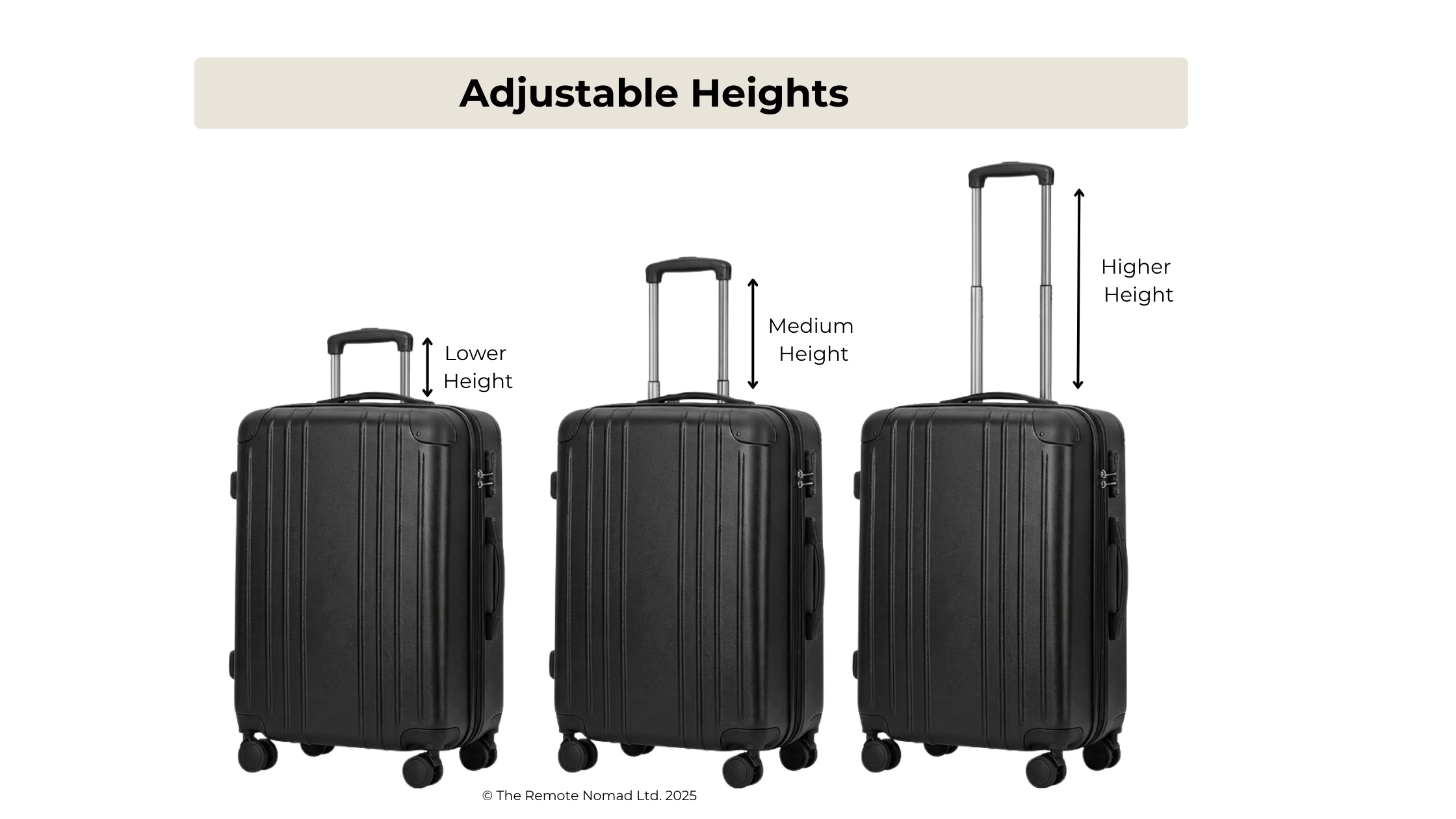
A good top retracting handle should feel solid, but just as importantly, it should adjust to multiple height settings, not just fully up or fully down. This matters more than people realize.
Multiple Height Adjustments
The height of the handle directly affects how much strain you put on your arm, shoulder, and back while you’re rolling your suitcase. If the handle is too high or too low for your setup, you end up compensating with your body without even realizing it.
Here’s how I think about it in real life:
When I’m traveling with a large suitcase and a carry on stacked together, I want both handles set at the same height so I can push or pull them comfortably with one hand. That usually means setting the large suitcase handle slightly lower and the carry on handle higher so everything lines up.
When I’m traveling with just the large suitcase, I prefer the handle higher so I’m not hunching or pulling at an awkward angle during long airport walks.
Having multiple height adjustments gives you that flexibility. A handle that only locks at one height forces you into one posture, whether it’s comfortable or not. Over long airport walks, that strain adds up quickly.
I also pay close attention to how the handle retracts.
Handle Retraction
When the handle retracts it should:
Slide smoothly,
Lock firmly into place, and
Fully collapse back into the suitcase without sticking out.
Anything loose or poorly fitted becomes another failure point over time.
And once you start paying attention to how the handle feels over distance, the next thing that becomes impossible to ignore is how the suitcase moves on its wheels.
Smooth Spinner Wheels Affect Your Entire Travel Experience
Bad wheels can ruin an otherwise good suitcase.
If your suitcase fights you, gets stuck, or constantly pulls to one side, it creates unnecessary frustration and physical strain, especially when you’re navigating long airport corridors, uneven sidewalks, or crowded terminals. And trust me, I’ve tried to travel with a damaged suitcase wheel that would constantly rejig direction every few minutes. It was annoying, especially at an airport.
Good spinner wheels glide. They move with you, not against you, even when the suitcase is fully packed.
Travel already comes with enough friction, lines, delays, and stress. Your suitcase should not add to it.
Why Wheel Design Matters More Than You Think
Not all suitcase wheels are designed the same way, and the differences matter once you travel enough.
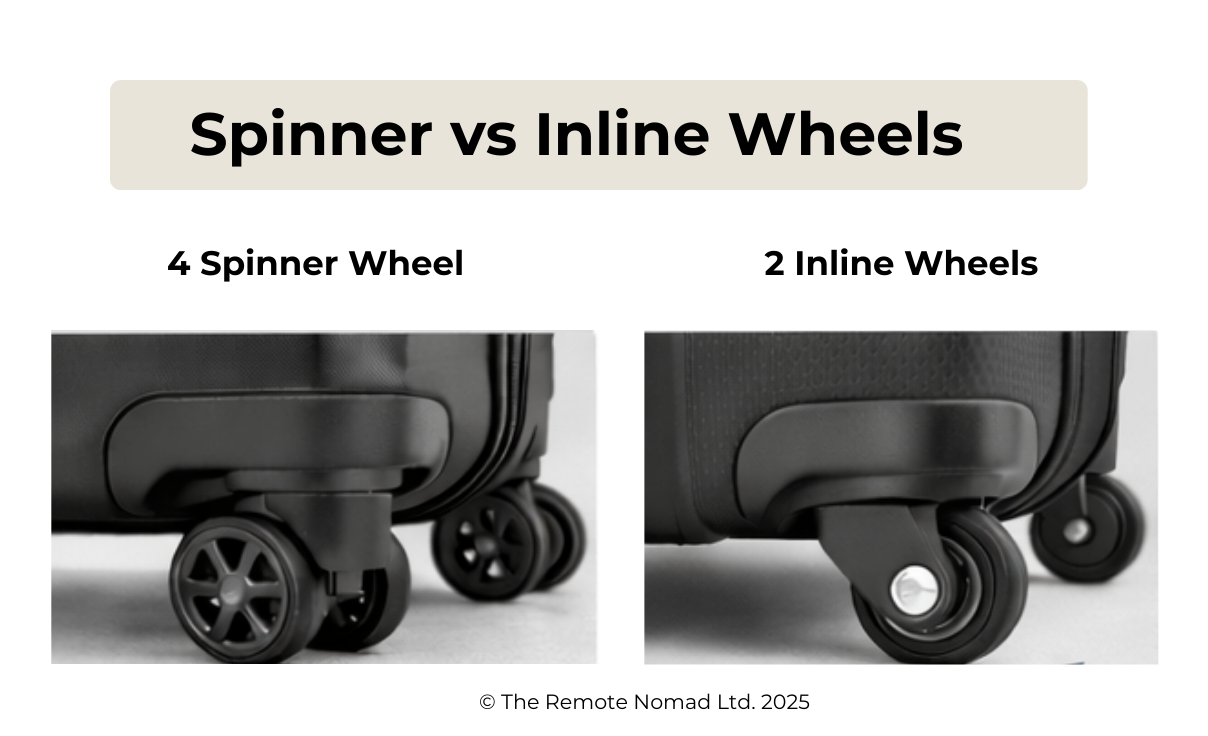
Most modern suitcases use four spinner wheels, which allow the bag to roll in any direction. That alone is a huge improvement over older two wheel designs, but even within spinner wheels, there are important variations.
One of the biggest differences you’ll notice is where the wheels are positioned.
Wheels Mounted on the Outside vs Inside the Suitcase
Some suitcases have wheels that sit more outside the shell, clearly protruding from the bottom corners. These are very common.
Pros:
They tend to roll very smoothly
They’re easier to clean
Debris is less likely to get trapped
Cons:
They’re more exposed
They can get cracked, bent, or smashed off during rough handling
They’re often the first thing to take impact when a bag is dropped
They can count against your suitcase or carry on size restrictions
Other suitcases have wheels that are more integrated or recessed into the suitcase body.
Pros:
Better protected from direct impact
Less likely to snap off if the bag is dropped
Often feel more stable when rolling
Cons:
Dirt, hair, or small debris can get lodged inside
You may have to fish things out to keep them rolling smoothly
If something gets stuck, the wheel can start dragging without you immediately noticing why
For me, I prefer mounted on the outside. Ultimately, if hair and debris get caught inside, I’m left to sort it out. And let’s be real, this annoyance is likely to happen. Whereas if the wheel snaps or breaks off, usually that’s something covered by warranty. The chance of this is less likely but if it does happen I’m covered. So ultimately, both have pros and cons but “one is covered by warranty and the other isn’t”. And now that I’m traveling more long haul these days, I’m ok with sacrificing size of my carry on as opposed to the few years prior I did a lot of short haul flights where that wheel on the outside made a difference for size restrictions.
But either way, knowing what you’re dealing with helps you choose intentionally.
What I Look For in Spinner Wheels
Beyond placement, here’s what I actually pay attention to.
The wheels should roll smoothly in all directions.
Not just forward and back. If the suitcase only wants to move one way, you’ll constantly be correcting it.
They should still glide when the suitcase is fully packed.
Some wheels feel fine when the bag is empty but struggle once weight is added. That’s a red flag. Having experienced this before, it’s incredibly annoying.
They should feel stable, not wobbly.
If wheels feel loose early on, that usually gets worse over time, not better.
Quiet, fluid movement matters more than speed.
I’m not trying to race through an airport. Wellll, I mean sometimes I am but I want a suitcase that moves predictably and doesn’t fight me.
Why This Impacts Your Body, Not Just Convenience
Wheels on a suitcase aren’t just about annoyance.
A suitcase that pulls to one side, sticks, or resists movement forces you to compensate with your body. Over long travel days, that strain adds up in your wrist, shoulder, and lower back. Again, I’ve personally lived this too. Not fun.
I’ve traveled with bags that required constant adjustment, and the difference when you switch to a suitcase with smooth, responsive wheels is immediate. You feel less tense, less rushed, and less worn down by the end of the day. I remember the day I switched to a proper four spinner carry on and it was an absolutely game changer for life and travel days.
Once you’ve experienced that, it’s very hard to go back.
And when wheels work the way they should, you start appreciating how much they quietly shape your entire travel experience. But even with a great suitcase, things can still break with heavy use. And when they do, having a solid warranty makes all the difference.
Warranties Are Not Optional
I look for warranties on suitcases now because I’ve actually had to use them.
In the past, I owned a luggage set from Heys, and after heavy use and a lot of overpacking, two things eventually failed. One of the wheels broke, and the interior lining ripped.
Both are incredibly common failure points.
Because the suitcase was still under warranty, I didn’t have to replace it out of pocket.But this is the part people don’t always talk about, the process.
The Process of Actually Using a Warranty
To get my carryon replaced under warranty, I had to call first, then bring the suitcase into their head office store, which was about a 40 minute drive for me. They assessed the damage, and from what I remember, they either attempt to repair it first or replace it if it can’t reasonably be fixed.
In my case, they replaced it.
The downside was that they didn’t have the same grey color I originally had. My color options were limited, and I ended up with a pink carry on instead. That part kind of sucked, because suddenly my matching luggage set didn’t match anymore.
But here’s the thing.
The replacement cost of that carry on would have been hundreds of dollars, and I didn’t pay a cent because it was covered under warranty. That alone made the inconvenience worth it.
What Luggage Warranties Typically Cover
Most reputable luggage warranties cover:
Broken or damaged wheels
Faulty zippers
Handle issues
Manufacturing defects
Interior lining or mesh failures due to normal use
They usually do not cover:
Cosmetic damage like scratches or dents
Damage from airline mishandling unless explicitly stated
Normal wear and tear beyond what’s considered reasonable
This is why it’s important to actually read what the warranty includes, not just assume everything is covered.
Why Wheels Matter Most When It Comes to Warranties
Wheels take an incredible beating.
They’re dragged over uneven sidewalks, slammed onto conveyor belts, yanked across terminals, and pushed while fully loaded. Once a wheel goes, the suitcase becomes miserable to use.
You can technically still travel with a broken wheel, but it’s awkward, exhausting, and puts extra strain on your body. Again, been there, done that.
That’s why I pay close attention to whether wheel damage is explicitly covered under warranty. It’s one of the most likely things you’ll need support for.
Why a Warranty Is Worth It Even If It’s Inconvenient
Yes, using a warranty can be a bit of a hassle. You may have to:
Call customer support
Bring the suitcase in or ship it out
Wait for assessment or replacement
Accept limited color or model options
But compared to replacing a suitcase that costs hundreds of dollars, it’s absolutely worth it.
If you’re spending real money on luggage and traveling frequently, a warranty isn’t a bonus feature. It’s protection against the most common and expensive failures.
And once you’ve saved hundreds of dollars by actually using one, you start paying a lot more attention to warranties than you ever did before. Not every suitcase feature deserves the same weight, and some matter a lot less in practice than people expect.

TSA Locks Are Situational, Not a Priority
This might surprise some people, but TSA locks rank low for me.
If airport security wants to open your suitcase, they will. The lock does not change that.
Where TSA locks are useful is when:
Leaving luggage with a hotel front desk
Using storage lockers
Temporarily storing bags during the day
If you do use a lock, it must be TSA approved. Otherwise, security can damage your suitcase to get inside.
I also learned this the hard way.
How to Actually Use the TSA Locks
I once locked my suitcase, forgot the combination, panicked because I had a flight to catch, and ended up cutting into my own suitcase.
The reason none of the codes worked was because I did not realize you have to press the side release after entering the code.
That suitcase did not survive that lesson.
So yes, TSA locks can be useful, but they are not what I base a purchase on. Now, again, maybe I’m just traumatized from ruining my wonderful suitcase because I didn’t realize you have to push the button after entering the code (incredibly embarrassing, I know). And now, I’m forever paranoid I’ll forget the code when I go to lock it.
That experience was a good reminder of something I’ve learned over time. Small features can be helpful, but they’re not what determine whether a suitcase actually earns my trust. When it came time to replace mine, I went back to what had proven itself long before any bells and whistles mattered.
After prioritizing what truly matters in function and durability, I also started paying attention to the small, practical details that quietly shape your travel experience, including color.
Color Choice: Practical, Visible, and Still Me
Color might seem like a superficial decision, but after years of travel, I’ve learned it actually affects your experience more than you’d expect.
Your suitcase is one of the first things people see you with when you’re moving through an airport. It becomes part of how you carry yourself, how put together you feel, and honestly, how you’re perceived. There’s a difference between looking like you rolled out of bed dragging a battered bag behind you and moving through the airport with something that feels intentional.
For me, suitcase design and color are an extension of that. It’s not about impressing anyone, but about how I feel while traveling. When I feel put together, I move differently. I’m calmer, more confident, and less frazzled, even on long travel days.
I’ve always believed that travel has a bit of energy to it. Airports are chaotic, flights are unpredictable, and small things can throw you off. Choosing something clean, simple, and well designed is one small way of bringing order into that chaos.
I joke that I aim for “first class energy” even when I’m flying economy. Maybe it’s manifestation, maybe it’s just mindset, but I’ve found that when I put a little effort into how I show up, travel feels less draining and more intentional.
And color plays a bigger role in that than people like to admit. Here are my personal thoughts and preferences on suitcase colour:
Why I Don’t Choose Black
One thing I don’t choose anymore is black.
Black suitcases blend in on baggage carousels
You second guess every identical bag rolling past
When you’re tired or tight on time, spotting your suitcase quickly matters more than you think
Black might work well for some people, and honestly, I can see how it makes sense for many men. But for me, it’s never quite felt right.
Wanting Something Feminine, But Not Flashy
I always want my suitcase set to feel a bit more feminine, something that still feels elevated and intentional.
At the same time:
I don’t want anything loud or gaudy
Bright colors and bold patterns aren’t my style
I still want something clean, simple, and elegant
I want a suitcase I’d feel confident walking into a five star hotel with. This is why I’m drawn to classic or traditional colours like beige, champagne or off-white.
The Color I Chose (And the Tradeoff)
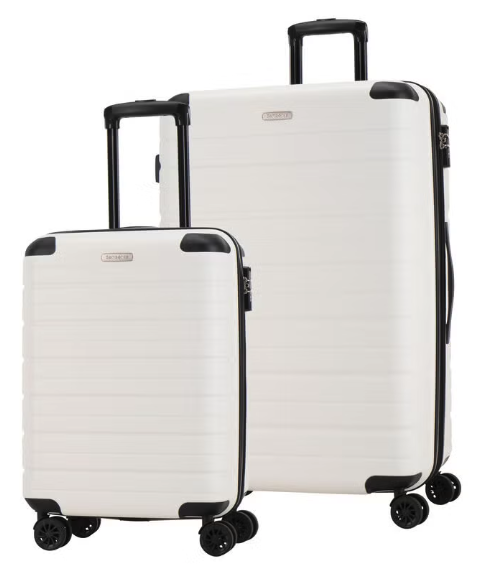
With my most recent suitcase purchase, I went with a white set with black trim. If you had asked me a year ago whether a white suitcase would be in my deck of cards, I would have said absolutely not. It feels impractical. The obvious concern is always the same, it shows dirt, scuffs, and marks more easily. I know.
Ideally, I would have chosen a soft cream or beige tone, something neutral but warmer. But once again, I was willing to trade color preference for a significant discount, and that compromise made sense for me.
The set dropped from around $500 to closer to $200
That tradeoff makes sense to me, for now, until I really decided to make a heavy investment in my luggage and since this decision was out of a practical necessity for a new suitcase. I’m satisfied knowing I’m getting quality and durability at a good price point. It makes me feel like I’m getting a ton of value.
Being Realistic About Wear and Tear
Again, I’m also realistic about white luggage.
It will get dirty
It will pick up scuffs, dents, and marks
But honestly, I’ve come to see those signs as a point of pride. Or at least that’s how I’m rationalizing it.
Scratches and wear mean the suitcase has been places. It’s been dragged across sidewalks, loaded onto planes, pulled through airports, and lived out of.
I’d rather have a well traveled suitcase with a story than something pristine that never leaves the house.
I’ll report back to you in a year or two and let you know if I still feel the same way about white as a colour choice and if it was worth it.
The Bigger Takeaway
At this stage, I choose luggage the same way I choose most things related to travel:
Practical first
Proven performance over perfection
Willingness to accept imperfections if it actually works for how I live and move through the world
That mindset has saved me money, stress, and more than a few frustrating travel days, and it’s exactly what I’d encourage anyone choosing a suitcase to keep in mind.
Why I chose Samsonite This Time
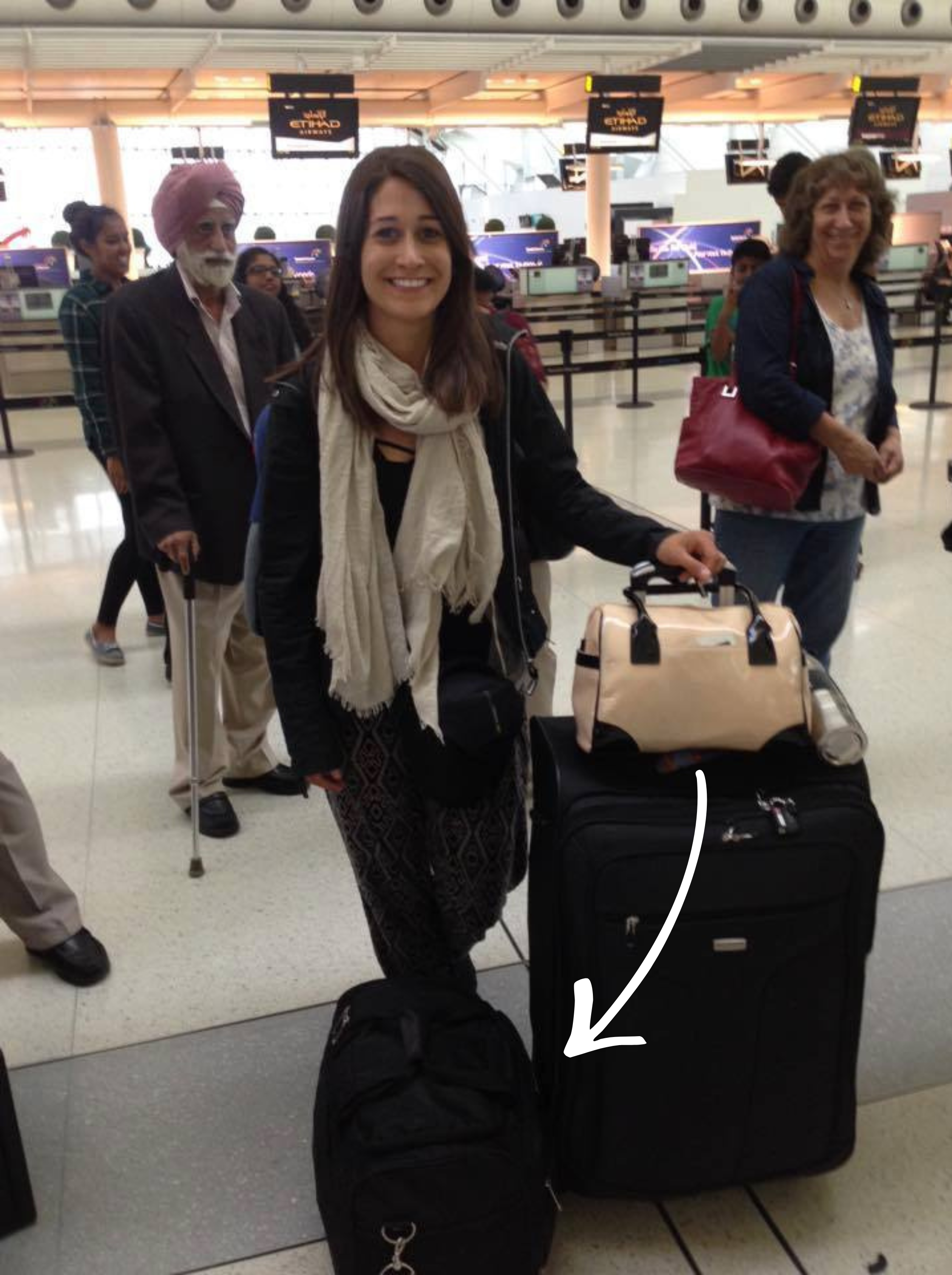
Years ago, I owned a Samsonite carry on with exceptional durability.The zipper never failed, which is rare.
The material held up incredibly well. I’m talking years of travel, including one full year of nonstop travel across 13 countries in 12 months. That carry on handled heavy use and constant overpacking without issue.
I eventually gave it away not because it broke, but because I decided to switch to wheeled carry ons.
That experience stayed with me.
I’ll be honest, I’m not someone who’s deeply familiar with every luggage brand on the market. I’ve tried a few over the years. Heys was solid and served me well for a time. Samsonite, though, has been the most consistently reliable in my experience. The only brand I see as a potential future splurge is Rimowa, more of an end goal suitcase than a practical one right now.
So when it came time to replace my luggage, I didn’t feel the need to overthink the brand decision. I went back to what had already earned my trust.
This time around, I chose a two piece Samsonite set, a carry on and a large suitcase only, because that’s how I actually travel.
My last set from Heys included a three piece setup, carry on, medium, and large. In practice, I almost always used the carry on and the large suitcase. I rarely travel with two checked bags, so investing in a full three piece set simply didn’t make sense for me.
How My Most Recent Suitcase Choice Measured Up
After everything I’ve learned over years of travel, I didn’t want to just buy a suitcase. I wanted to choose one intentionally, knowing exactly what I was getting, what I wasn’t, and why.
This time around, I went with the Samsonite Intrigue Spinner 2 Piece Set (Carry On + Large). I bought it during a holiday sale, which heavily influenced the final decision.
Here’s how it stacked up against the criteria I care about most.
What I Got Right (Based on My Priorities)
✔️Quality and durability
he set is made from an ABS and polycarbonate blend. While it’s not full polycarbonate, it offers good impact resistance without being overly heavy, which was a fair tradeoff at this price point. And the Samsonite brand is known for durability (and I’ve experienced it first hand).
✔️Expandable large suitcase
The large suitcase expands, which was non negotiable for me. It gives me flexibility when packing and reduces strain on the main zipper.
✔️Multi stage retractable handle
The handle adjusts to multiple heights, which matters for ergonomics when stacking luggage or rolling the large suitcase on its own.
✔️Retracting top and side carry handles
Both handles sit flush against the case, reducing snagging and making lifting easier on the body.
✔️Spinner wheels
The dual spinner wheels glide smoothly and handle full weight well, making long airport walks noticeably easier.
✔️TSA approved lock
Not a top priority for me, but useful for hotel storage and peace of mind.
✔️Warranty
The set includes a limited 10 year global warranty, which matters to me after having used warranties in the past for wheels and interior damage. 10 years is incredible. I’m sure I’ll want to change my suitcase before then just for the sake of getting something fresh but I’m satisfied knowing I’ve got 10 years coverage.
What I Didn’t Get (And Was Okay With)
Full polycarbonate shell
I would have preferred full polycarbonate, but the price difference didn’t justify it this time.
Expandable carry on
Only the large suitcase expands. I would have really liked expandable because I often use my carry on for weekend trips where I tend to overpack, but for the sense of travel and airport, my carryon has to be certain dimensions anyways.
My ideal color
I would have chosen cream or beige if given the option. I did consider the soft pink, but it didn’t feel as timeless or elegant. Instead, I went with white and black trim due to limited sale colors.
The Practical Tradeoffs I Made
This purchase was about balancing practicality with cost.
Regular price was around $500
Sale price dropped it closer to $200
The warranty alone protects against hundreds of dollars in future replacement costs
I also intentionally skipped the medium suitcase.
Why:
I rarely use it
I usually check one large bag and carry one carry on
I wanted a matching set without unnecessary pieces
For how I travel, a two piece set made more sense.
The Numbers That Actually Matter
Carry On
Weight: 7.2 lbs (nice and light)
Exterior: 21.5” x 15.0” x 9.0”
Large Suitcase
Weight: 10.6 lbs (empty)
Exterior: 30.5” x 20.0” x 12.4”
Expandable
These weights leave plenty of room for packing without constantly stressing about limits.
Color Choice: Practical, Visible, and Still Me
With this purchase, I went with a white set with black trim. If you’d asked me a year ago whether I’d choose white luggage, I would have said absolutely not. It feels impractical. It shows dirt, scuffs, and marks more easily. I know.
Ideally, I would have chosen a soft cream or beige tone, something neutral but warmer. But I was willing to trade color preference for a significant discount, and that compromise made sense for me.
Being Realistic About Wear and Tear
I’m realistic about white luggage.
It will get dirty
It will pick up scuffs and dents
But I’ve come to see those signs as a point of pride. Or at least that’s how I’m rationalizing it for now.
Scratches mean the suitcase has been places. It’s been dragged across sidewalks, loaded onto planes, pulled through airports, and lived out of.
I’d rather have a well traveled suitcase with a story than something pristine that never leaves the house.
I’ll report back in a year or two and let you know if I still feel the same way about white.
The Bigger Takeaway
At this stage, I choose luggage the same way I choose most things related to travel:
Practical first
Proven performance over perfection
Willingness to accept imperfections if it actually works for how I live
That mindset has saved me money, stress, and more than a few frustrating travel days.
And that’s ultimately the point of this entire post.
Once you understand what truly matters for your travel style, choosing a suitcase becomes far less overwhelming and far more intentional.
Final Thoughts
After years of travel, my approach is simple.
I would rather own one durable suitcase that lasts than replace cheaper ones over and over again.
Strong zippers. Durable materials. Smooth wheels. Solid handles. A real warranty.
Everything else is secondary.